Your domain name is the first thing people see, type and remember about your business online. Choose well, and it works for you for decades. Choose badly, and you spend years spelling it out over the phone. Here is how to pick a good one, in plain language, with South African examples.
What is a domain name, and why does it matter?
A domain name is your business's address on the internet, like mamasbakery.co.za. People type it to find your website, and it is the part after the @ in your email address: orders@mamasbakery.co.za.
A good domain name:
- makes you look professional (compare mamasbakery.co.za with mamasbakery123@gmail.com),
- is easy to remember and share, by word of mouth, on WhatsApp or on the side of your bakkie,
- belongs to you, so you can move your website or email to another provider and keep the address.
.co.za, .com or something else?
The part after the dot is called the domain ending (or extension). Here is how the main choices compare for a South African business:
- .co.za: South Africa's own business ending and the one most South Africans trust and recognise. It tells customers you are local. The best first choice for most South African businesses.
- .com: the world's best-known ending. Useful if you sell to other countries, and worth registering alongside your .co.za so nobody else can take it.
- .org.za: for non-profits, churches, clubs and community organisations.
- .africa: a pan-African ending, a good fit if you trade across the continent.
- Newer endings like .shop, .online or .store: they can be fun and descriptive, but many people still expect .co.za or .com, and some newer endings cost more to renew.
9 rules for a good business domain name
1. Keep it short
Shorter names are easier to remember, type and fit on a business card. Aim for two or three short words at most.
2. Make it easy to say and spell
Try the radio test: if you said your domain on the radio, could listeners type it correctly? Avoid unusual spellings (kwik instead of quick) and words people often misspell.
3. Avoid hyphens and numbers
Is it best-braai.co.za or bestbraai.co.za? Is it 4 or four? Hyphens and numbers cause mistakes and send customers to the wrong place. Use them only if there is no better option.
4. Use your business name if you can
Your domain should match the name on your shopfront, invoices and social media. That way customers can guess your website without searching.
5. Consider a keyword or your town
If your business name is taken, adding what you do or where you are often helps: mamasbakerydurban.co.za or mamascakes.co.za. It also tells people what you do before they click.
6. Think about the future
capetowniphonerepairs.co.za works today, but what if you move to Stellenbosch or start fixing Samsungs too? Leave yourself room to grow.
7. Check it doesn't mean something odd
Read the words run together. Some combinations read badly when there are no spaces. Ask a friend to read it out loud before you buy.
8. Stay clear of other people's brands
Don't use a famous brand or a competitor's trademark in your domain, even with a twist. It can lead to a dispute and you could lose the domain. A quick search on the CIPC website shows whether a business name or trademark is already registered.
9. Check your social media names too
Before you buy, check whether the same name is free on Facebook, Instagram and TikTok. Matching names make you easier to find everywhere.
Common mistakes to avoid
- Registering in someone else's name. Make sure the domain is registered in your name or your business's name, not your web designer's or a friend's. The registrant is the legal owner.
- Letting it expire. An expired domain takes your website and email down with it, and someone else may register it. Keep your contact details up to date and renew on time, or for several years at once.
- Waiting too long. Good names go quickly. If you've found one that's free, register it now, even if your website is months away.
- Choosing something too clever. A pun might make you smile, but customers need to remember it and type it.
How to register your domain
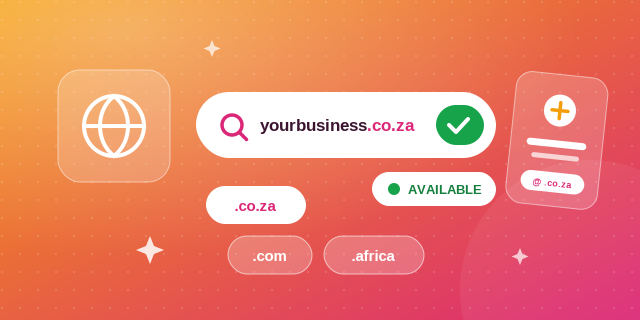
- Search for your name in our domain search. You'll see straight away whether it's free.
- Pick your endings: usually .co.za, plus .com if you want to protect your brand.
- Choose how many years: Afriweb lets you register and renew for up to five years at today's price.
- Add hosting if you want a website and email on your new domain. Every Afriweb hosting plan includes a free, professionally designed website.
Already have a domain somewhere else? You can move (transfer) it to Afriweb; the price is on our domain pricing page.
Starting an online shop?
Your domain name is one of the first steps to selling online. Our free online ecommerce course has a whole chapter on choosing your shop's name and domain, and helps you build a shop plan as you go. For a quick overview of what else you'll need, read how to choose web hosting in South Africa and our website checklist for small businesses.
Frequently asked questions
Should I choose .co.za or .com for my South African business?
For most South African businesses, .co.za is the best first choice: it is the ending local customers recognise and trust. If you sell abroad or want to protect your brand, register the .com as well and point it to your .co.za website.
Can I register a .co.za domain if I don't have a company?
Yes. You don't need a registered company to register a .co.za domain. Sole traders, freelancers and people starting a side business can register one in their own name.
What happens if my domain name expires?
Your website and email stop working, and after a while the name can be registered by someone else. Renew on time, keep your contact details up to date, or renew for several years at once.
Can I change my domain name later?
You can register a new name at any time and redirect the old one to it, but changing means new business cards, signs and links. It is worth taking a little time to choose well from the start.
Can I move my domain to another provider?
Yes. A domain registered in your name belongs to you, and you can transfer it to another registrar, keeping the same address.